

Nationalité Immigré: A Review
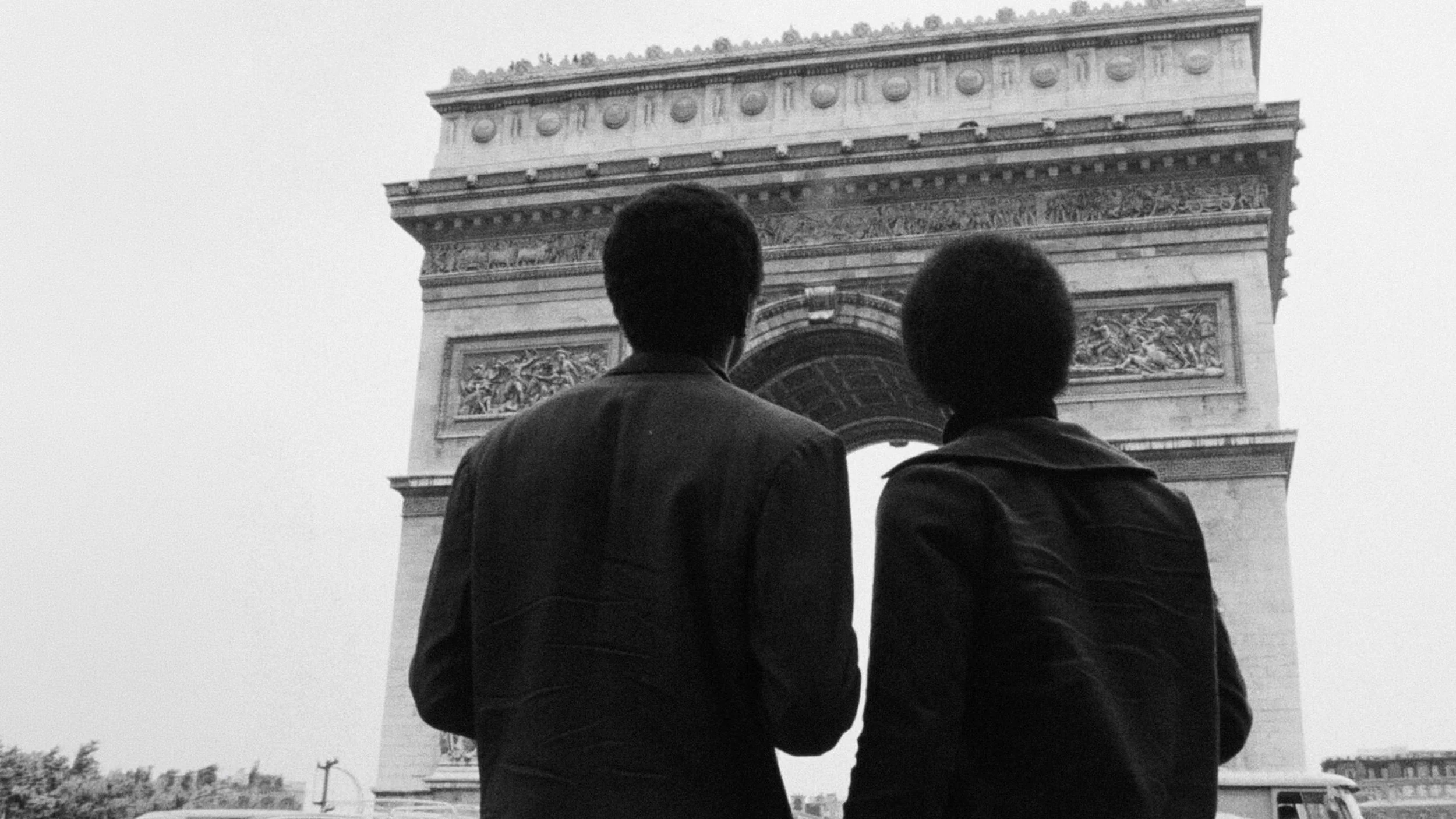
Nationalité: Immigré is a time capsule for the migrant working class of today. Sidney Sokhona’s 1976 directorial debut, immerses its audience into an 85 minute plunge through the streets and slum shelters of surrealist Paris. The film is a ‘lost’ bijou of documentary and fiction (docu-fiction) in which the director is transformed into our main character, Sidi — a young Mauritanian man recently immigrated to Paris smuggled inside of a car boot. In its first ten minutes, Nationalité: Immigré lays out its concerns via Sidi’s search for pathways to ‘legal’ immigration, dignified work and safe housing, resulting in an unflinching critique of the ever oppressive franc.
Filmed over the course of three years, from 1972 to 1975, Sidi’s arrival into a gritty Paris is anchored by the focal point of his new accommodation, the Rue Riquet hostel; an overcapacity slum shelter housing 300 immigrant workers with two taps, two toilets, no bedroom windows or light switches between them. Subsequently, the hostel is positioned as a simmering ignition point for organising rent strikes and mutual aid networks. Weaving his own personal narrative into the scenes, Sidney Sokhona blurs the lines as a director who takes up the role of a main character in a story based on his own life. Sidi’s story is a direct reflection of Sidney’s; two Black immigrant teenage boys from Mauritania battling a hostile Paris from the Rue Riquet.
Contrast! The opening of the film is set a black and white colour-grade so stark it startles. Two white men in business-casual attire sit, foregrounded, at a table. The white of one of their shirts almost glows as they sit behind a table in a park, scribbling on papers with bureaucratic purpose. The concrete in the background and the grass of the park merge into a prolonged shock of grey as a jump cut suddenly reveals three men just to the right of the table. Due to the over-exposure of the lighter tones — the darker tones, the blacknesses, are rendered so much richer. Sidi’s dark face is well lit and defined on camera as well as striking at times against the white, white backdrop of Paris’ cityscape. This prioritisation of visual clarity for all of the black African characters in the film recenters blackness even in its joint struggle for black African, North African, Portuguese and Spanish migrant workers’ rights. These men, on their knees, come to the table, receive a piece of paper scribbled with a housing allotment and sluggishly crawl away.
From this opening metaphor of degrading subjugation, it is apparent that Sokhona’s mission is to contrast the white ‘progressive’ fantasy of immigration as a means of providing equal opportunity to workers from ‘under-resourced’ countries and the reality of ninety percent of immigrants in France. Voice-overs carry us into the rest of the film as we’re shown footage of Sidi relentlessly looking for work on jobsite after jobsite or slow pans across a noticeable dark room, overcrowded with beds and clothes trunks in Rue Riquet. One of the most moving slippages of the contrasting masks of immigration happens in the first ten minutes of the film where Sidi is explaining to a white progressive, later turned ally, about why people immigrate ‘illegally’.
His voiceover begins as we are transported to a Mauritania steeped in black and white, ‘long before the colonisers arrived’. Sidi describes a time before currency. A time where trade and bartering were how people got their needs met. A time before the disintegrating force of colonial contact and the following floods of money that resulted, imposing taxes on crops and livestock, rural workers sucked into big cities and then, finally, not enough jobs to go around. We’re tilted back in the present day and the scene bursts back into color. Blink and you might miss it. There’s muted green water. Everyone is dark-skin. The men are working hard. Sidi explains the need to emigrate to Europe from Africa while also explaining that, ‘Everyone knows the French economic machine needs immigrant workers.’ The contrast is pulled from black-and white into colour as the narrative expands into the history between Europe under-developing Africa, problematizing the migration of people from countries colonially exploited first through under-development and then again through the precarity of hiring them for hazardous jobs at unliveable wages.
Alongside the firmly set tonal contrast; a settled trust accompanies each scene. It didn’t feel like Sokhona was telling us what to think. Despite the film’s irony, the education Sokhona offers the viewer, simple facts and unassumed images, remains fluid enough for us to come to our own conclusions about the tensions of the social conditions boiling over in 1970’s Paris. While we’re coming to our own viewpoints about what Sidi’s persistence means, Sokhona interweaves schematics of a timeless adage: When we fight, we win. In the last thirty minutes of the film, seven deaths of migrant workers catalyse the residents of the shelters and slums into resistance. Trench-coated on a bridge, Sidi tells us, ‘We had to organise ourselves to fight, otherwise we would all die.’ The resistance begins with rent strikes. A committee of residents begin engaging in political education to learn how the exploitation of their labour pays for the social safety nets of neo-liberal France. Black African elders of Rue Riquet enter negotiations with a white Frenchman mediator to be relocated to a new shelter that can house all 300 residents, together, to not break up kinship ties and solidarity. Sidi and his fellow residents hit the paved streets with an all too familiar and new awkwardness: where do we flyer? Who should we give this manifesto-clad handout? They do it scared and unsure. They do it awkwardly and bravely and eventually as the scene goes — they become more confident in the presence of their kin at the shelter — they begin to read their written speeches laden with takedowns of racism and xenophobia to streets of Parisian onlookers moving glassy-eyed, curious, disgusted or intrigued enough to stand still and listen.
The trajectory of Sidi and his fellow residents finding their voices and understanding their rights arcs in a rallying fight which they eventually win. Managing to outmaneuver underhanded landlord tactics to separate them in the shelter, all 300 residents are re-housed into better conditions after staying united and realising their power as one singular bloc. Shattering sentiments of gratitude, Sokhona rejects the notion that they should be grateful, gesturing to how their newfound collective power only marks the beginning of their resilience.
As the short end credits rolled, a question spurred inside me, my mind — wrapped in Sokhona’s biography, the black and white richness of his cinematography, and, at times, the film’s tongue and cheek approach to resisting racism and xenophobia in 1970’s France — I asked myself, Why film? The answer comes quickly while reading Sokhana’s essay, Our Cinema, where he writes, ‘...cinema, used properly, can be a messenger between people.’Nationalité: Immigré reveals itself as a half-a-century portal; a messenger between two times, showing us that the reasons for emigrating and the oppression experienced in the Imperial Core are the same ones between France in the ‘70’s and the UK today. The 300 residents in Rue Riquet are the 39 seekers of asylum who were imprisoned on the Bibby Stockholm, people fleeing the ongoing violences of colonialism, exposed to intense psychological and emotional stressors as well as Legionnaires’ disease. Sokhona’s resident’s conditions are the mirrored experience of those in the Migrant Voice’s 2023 report on asylum hotels, places with ‘poor food, lack of privacy, overcrowding, substandard bathroom and toilet facilities, filthy rooms,’ places, ‘with no cleaning supplies… unable to wash their clothes.. and lack of… adequate healthcare.’ Just as Sidi and his kin battle the hostility of Parisians, we find the same spirited templates for gathering, dismantling and resisting disinformation about migrants; staying unified and crucially remaining unafraid to speak and act. The adage reverberates, ‘When we fight, we win’; a talisman amidst the xenophobic pressures we must remember as old as we face them. When we continue to drive away xenophobic hatred, we reignite these histories of unifying to resist colonial violence, It’s in finding these answers to my questions within Sokhana’s cinematic message that the apathy from the constant digestion of this horrific late-stage white supremacy, is powerfully burned beneath a black and white flame. For this — Nationalité: Immigré is a five out of five star film; a must see for any of us needing to shake the feelings of powerlessness regarding our current surroundings.
With thanks to REC for screening Nationalité Immigré at The Old Print Works, Moseley.